
Victoria eugenia aguirre cardona. historia patología
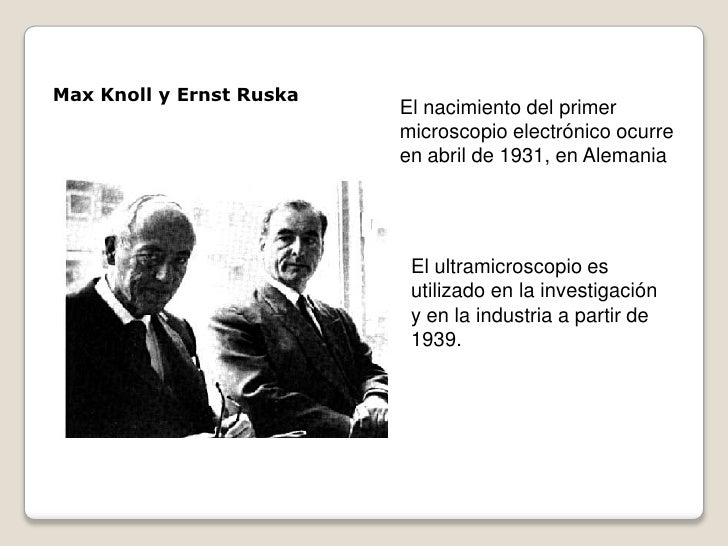
In a few years' time, the electron microscope will be 100 years old. The ideas leading to the invention of the instrument emerged in Berlin between 1928 and 1933. Ernst Ruska is the undisputed.
Max Knoll and Ernst Ruska Electron Microscope YouTube

Co-Founders Ernst Ruska and Max Knoll (German) won half of the nobel prize in physics in 1986 for this invention. In this type of microscope, a vacuum speeds up all the electrons forcing their wavelength to be very short. This means that only one hundredth - thousandth of a wavelength speeds the electrons making them move very fast.
El microscopio electrónico Biología

Timeline of Ernst Ruska and the development of the TEM. A. The first instrument, developed in 1931. B. The second instrument in 1931. Pictured here with his mentor, Max Knoll. C. The second instrument in 1931. D. The third instrument in 1933, capable of higher magnification than a light microscope. E. Ernst Ruska, 1939. F.
First Electron Microscope Johnson & Johnson Our Story

Other articles where Knoll, Max is discussed: electron microscope: History:.by 1931 German electrical engineers Max Knoll and Ernst Ruska had devised a two-lens electron microscope that produced images of the electron source. In 1933 a primitive electron microscope was built that imaged a specimen rather than the electron source, and in 1935 Knoll produced a scanned image of a…
06 microscopios
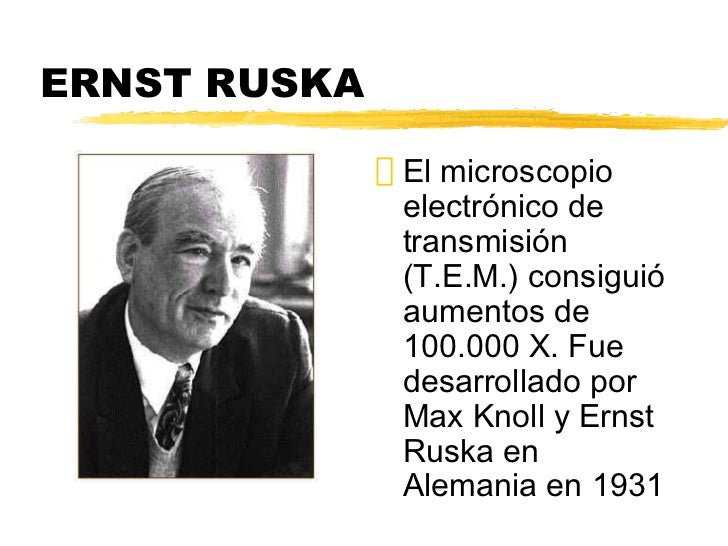
Ernst Ruska (born Dec. 25, 1906, Heidelberg, Ger.—died May 27, 1988, West Berlin) was a German electrical engineer who invented the electron microscope.He was awarded half of the Nobel Prize for Physics in 1986 (the other half was divided between Heinrich Rohrer and Gerd Binnig).. Ruska studied at the Technical University of Munich during 1925-27 and then enrolled at the Technical.
NobelPrize 1986, Ernst Ruska, Electron Microscopy YouTube

By Science News. January 1, 1931 at 7:08 pm. The electron microscope is invented by Max Knoll and Ernst Ruska (shown), allowing for the investigation of a wide range of materials, including.
The optical microscope changed the science field forever. German physicist Ernst ruska and The

In fact, Ernst Ruska and Max Knoll, his supervisor, had designed, constructed, and exhibited a prototype electron microscope in Berlin in 193 1, well before the acceptance date of the patent, and so, under German law, were co-users of the patent. Unfortunately, Knoll died in 1969, so ajoint Knoll-Ruska award of the Nobel Prize was not possible..
Ernst Ruska Electron Microscope
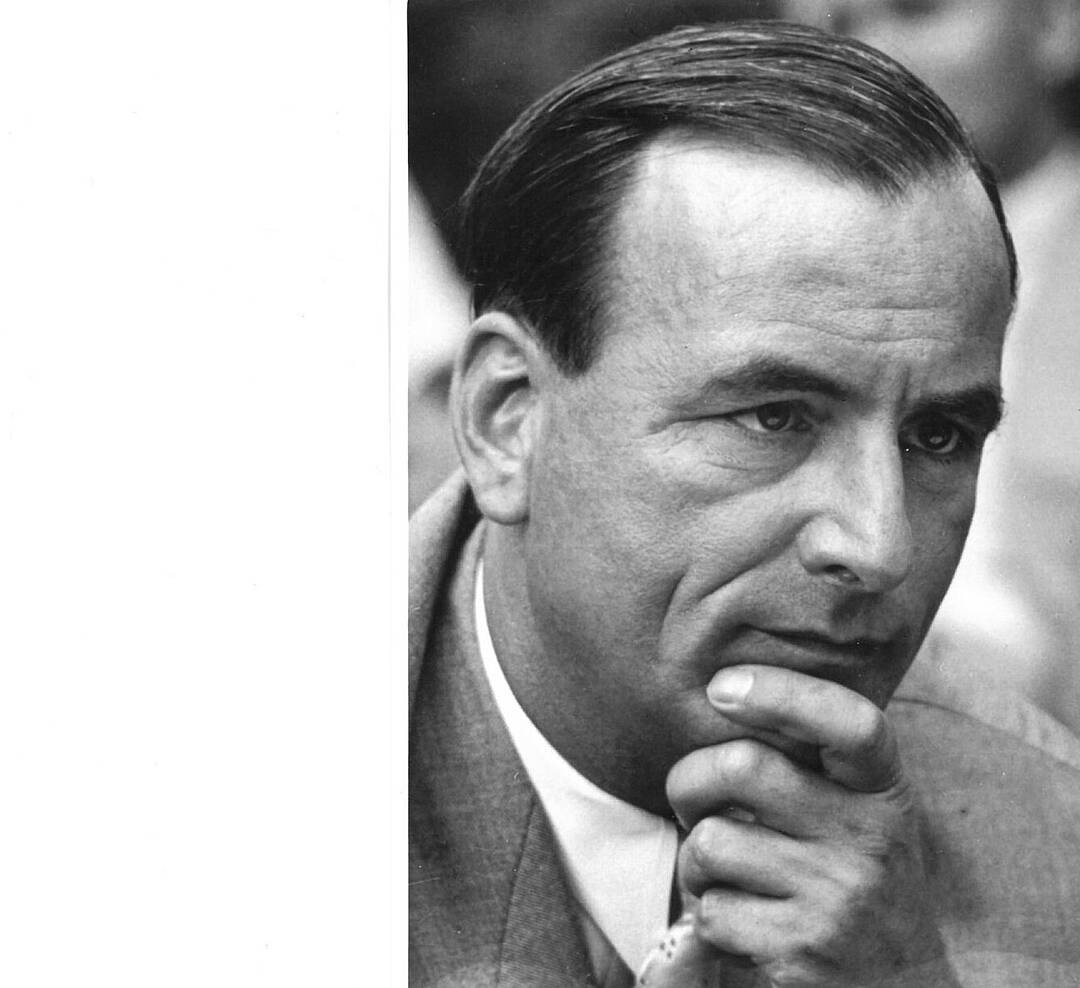
By 1931, Max Knoll had became more and more involved in completing his habilitation treatise, and Ernst Ruska and Bodo von Borries began a close cooperation in designing and constructing electromagnetic lenses suitable for focusing a beam of electrons in a cathode ray oscillograph (von Borries & Ruska, E. 1932).
La tercera ley de Clarke Fitopasión

Timeline of Ernst Ruska and the development of the TEM. A. The first instrument, developed in 1931. B. The second instrument in 1931. Pictured here with his mentor, Max Knoll. C. The second instrument in 1931. D. The third instrument in 1933, capable of higher magnification than a light microscope. E. Ernst Ruska, 1939. F.
First Electron Microscope 1931

The electron microscope, which was invented by Ernst Ruska and Max Knoll in 1933, made it possible to take pictures of much smaller objects than was previously possible. Ernst Ruska's brother, Helmut Ruska, was a doctor and biologist, and used early electron microscopes to make images of viruses and other small objects.
On March 3, 1931, German physicist Ernst Ruska together with his doctoral advisor Max Knoll

Matter-wave microscopy can be dated back to 1932 when Max Knoll and Ernst Ruska published the first image obtained with a beam of focussed electrons. In this paper a new step in the development of matter-wave microscopy is presented. We have created an instrument where a focussed beam of neutral, ground-state atoms (helium) is used to image a.
German physicist ERNST RUSKA (December 25, 1906 May 27, 1988) won the Nobel Prize in Physics

Ernst Ruska constructed the first transmission electron microscope (TEM) with his mentor Max Knoll Electron microscope constructed by Ernst Ruska in 1933 Ernst August Friedrich Ruska ( German pronunciation: [ɛʁnst ˈʁʊskaː] ⓘ ; 25 December 1906 - 27 May 1988) [1] was a German physicist who won the Nobel Prize in Physics in 1986 for his.
History of Electron Microscopy Resources Electron Microscopy Center Indiana University
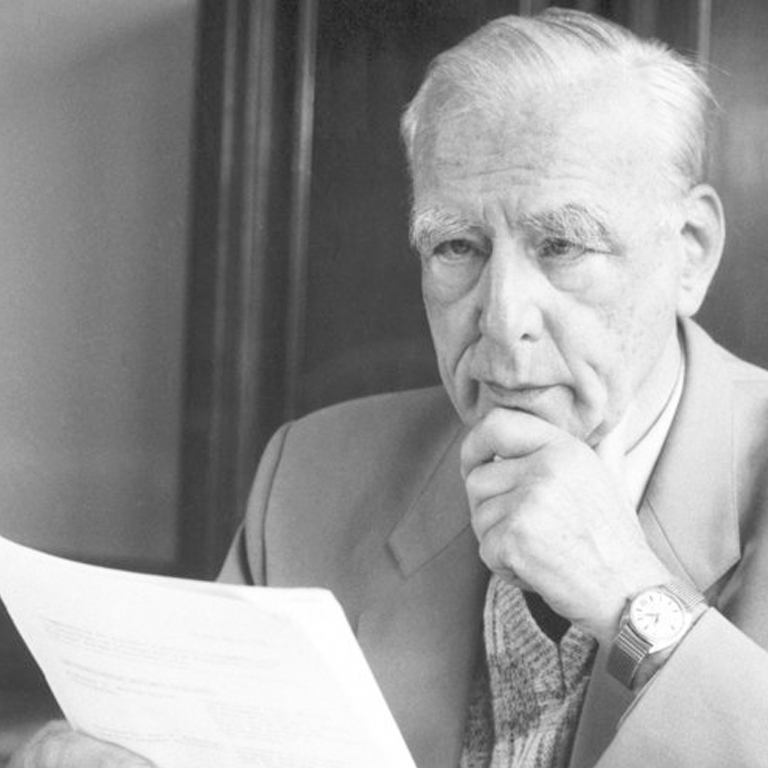
Ernst Ruska, Max Knoll and the Technische Hochschule1.1. Background. The fact that the first prototype of a transmission electron microscope was constructed at the Hochspannungslaboratorium (High Tension Laboratory) of the Technische Hochschule in Berlin is undisputed.
Ernst Ruska Electron Microscope
Sketch by Ernst Ruska, dated 9 March 1931, of the cathode ray tube for testing one-stage and two-stage electron-optical imaging by means of two magnetic electron lenses ("electron microscope"). The first electron microscope demonstrated by Max Knoll and Ernst Ruska in 1931 at the Technical University of Berlin. Ruska finished his Ph.D. in 1933.
Scientific breakthroughs from the year you were born

Max Koll and Ernst Ruska. German engineer and Nobel Peace Prize winner, Ernst Ruska designed and built the first electron microscope which allowed scientists to view things that were too small to be viewed by the light microscope. In 1931, Ruska, began to work closely with fellow German Max Knoll to co-invent the first electron lens, an.
Electron Microscope Introduction, Types, Differences and Its Applications

Max Knoll 1897 - 1969 occupation: Electrical engineer Nationality: German born in: Wiesbaden, Darmstadt, Hesse, Germany. Co-invented the electron microscope with the physicist Dr Ernst Ruska Related people Ernst August Friedrich Ruska Related Objects. Replica of the first electron microscope (microscope; electron microscope; replica).